
Another 4/20 has come and gone — and the 2026 data is officially in. While the cannabis holiday has long been defined by massive foot traffic and celebratory energy, this year marked a clear turning point in how that energy was captured and converted. These 4/20 Takeaways reflect what the data actually showed: for cannabis retailers, the story of 4/20 2026 isn’t just about total sales volume — it’s about the technological infrastructure that allowed the winners to scale while others hit bottlenecks.
At BLAZE, our commitment to 100% uptime was the foundation for these results. On the biggest cannabis sales day of the year, preparation and scalability are the only things standing between a record-breaking day and a missed opportunity.
Based on the performance of our retail partners, here are the top 4/20 takeaways every dispensary operator needs to understand.
AI-Powered Recommendations Drive a 47% Lift in Average Order Value
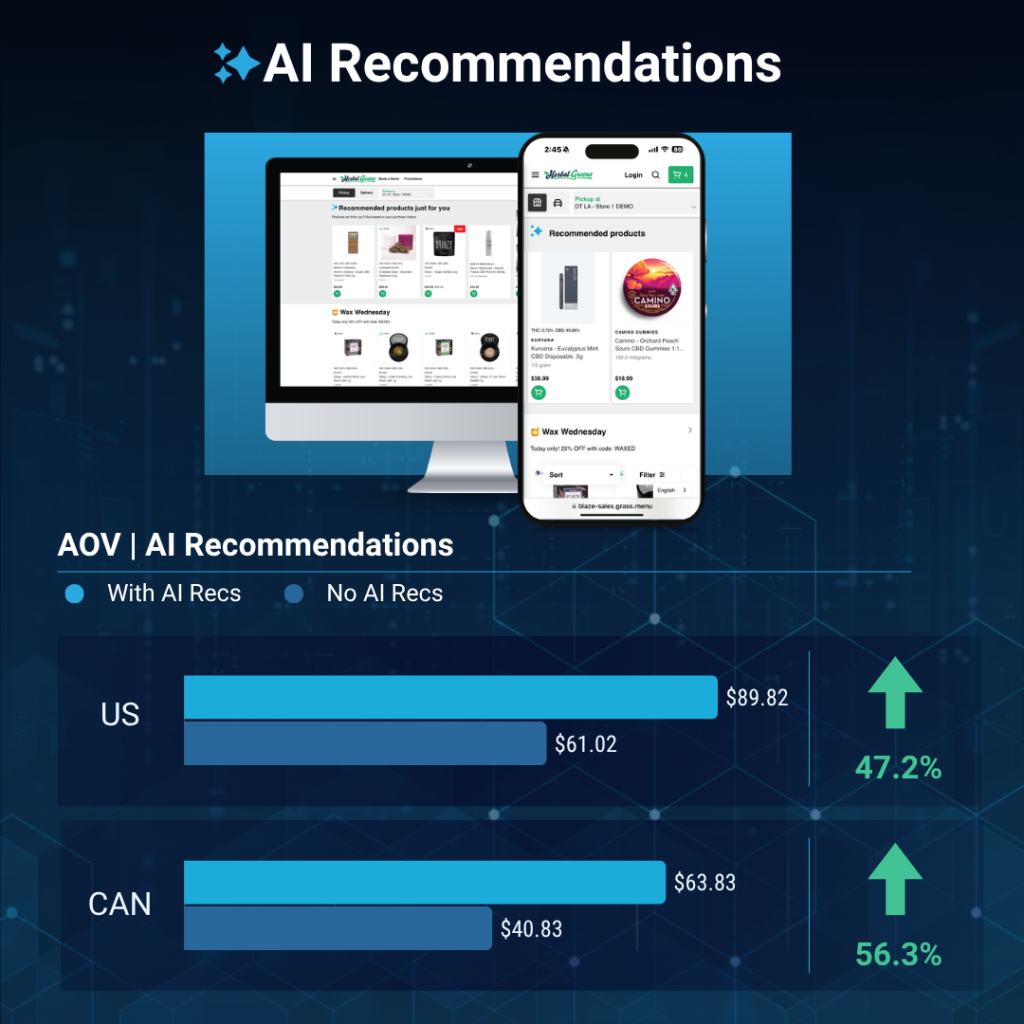
The most significant revenue trend of 4/20 2026 was the integration of AI into the online shopping experience. In the US, AI-powered product recommendations drove a 47% increase in average order value (AOV) — from $61.02 to $89.82. In Canada, the lift was even greater: 56% ($40.83 to $63.83).
These weren’t random suggestions. Real-time analysis of a customer’s purchase history and current cart produced personalized product pairings that built larger baskets naturally, without friction. AI upselling is no longer a budtender skill — it’s a software-driven science.
What makes AI recommendations particularly powerful in cannabis retail is the complexity of the product catalog itself. With hundreds of SKUs spanning flower, edibles, concentrates, and topicals — each with varying potency, effect profiles, and price points — no human budtender can hold every pairing in mind for every customer simultaneously. AI doesn’t get overwhelmed. It surfaces the right product at the right moment, every time, whether that’s a first-time buyer exploring low-dose edibles or a returning customer ready to trade up to a premium concentrate.
Looking ahead, the gap between dispensaries using AI recommendations and those that aren’t will only widen. Consumers trained by Amazon now expect personalized suggestions as a baseline — not a bonus. Cannabis retailers that deliver this experience will see compounding benefits: higher AOV today, stronger retention tomorrow, and a customer data flywheel that makes every future recommendation smarter. Those who don’t risk feeling increasingly generic in a market where differentiation is everything.
Dispensary Mobile Apps Grew 342% Year-Over-Year
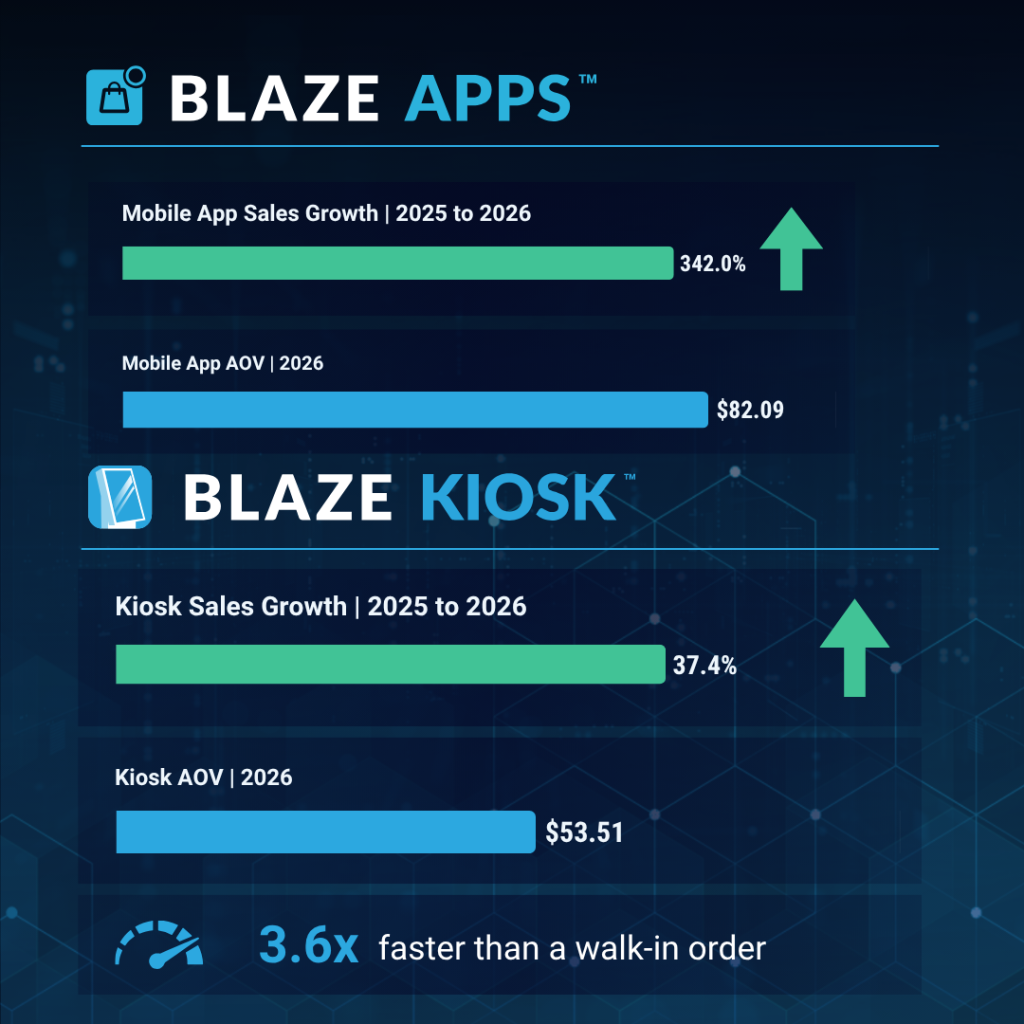
If there was a breakout star of 4/20 2026, it was the dispensary mobile app. While digital sales surged across every channel, mobile apps delivered a 342% year-over-year increase.
Conventional wisdom says consumers are “app-fatigued.” The 2026 data disproves this: customers aren’t resistant to apps — they’re resistant to apps that offer no value. In-app exclusive deals gave shoppers a compelling reason to download, engage, and buy. Mobile is no longer a nice-to-have for cannabis retailers. It is the primary driver of digital dispensary sales.
Kiosks Cut Transaction Time by 29 Minutes
The biggest risk on 4/20 is the bottleneck — the moment lines go out the door and frustrated customers leave. Self-serve kiosks are now the frontline defense against that outcome, with kiosk sales growing 37% year-over-year in 2026.
The efficiency data is striking. Kiosks processed orders in an average of 10.8 minutes versus 39.6 minutes at the standard retail counter — a 29-minute difference on the highest-traffic day of the year. Kiosks don’t replace budtenders; they free them to focus on high-value, consultative interactions that drive basket size and loyalty.
Walk-In Traffic Held Strong — and the Hybrid Shopper Emerged
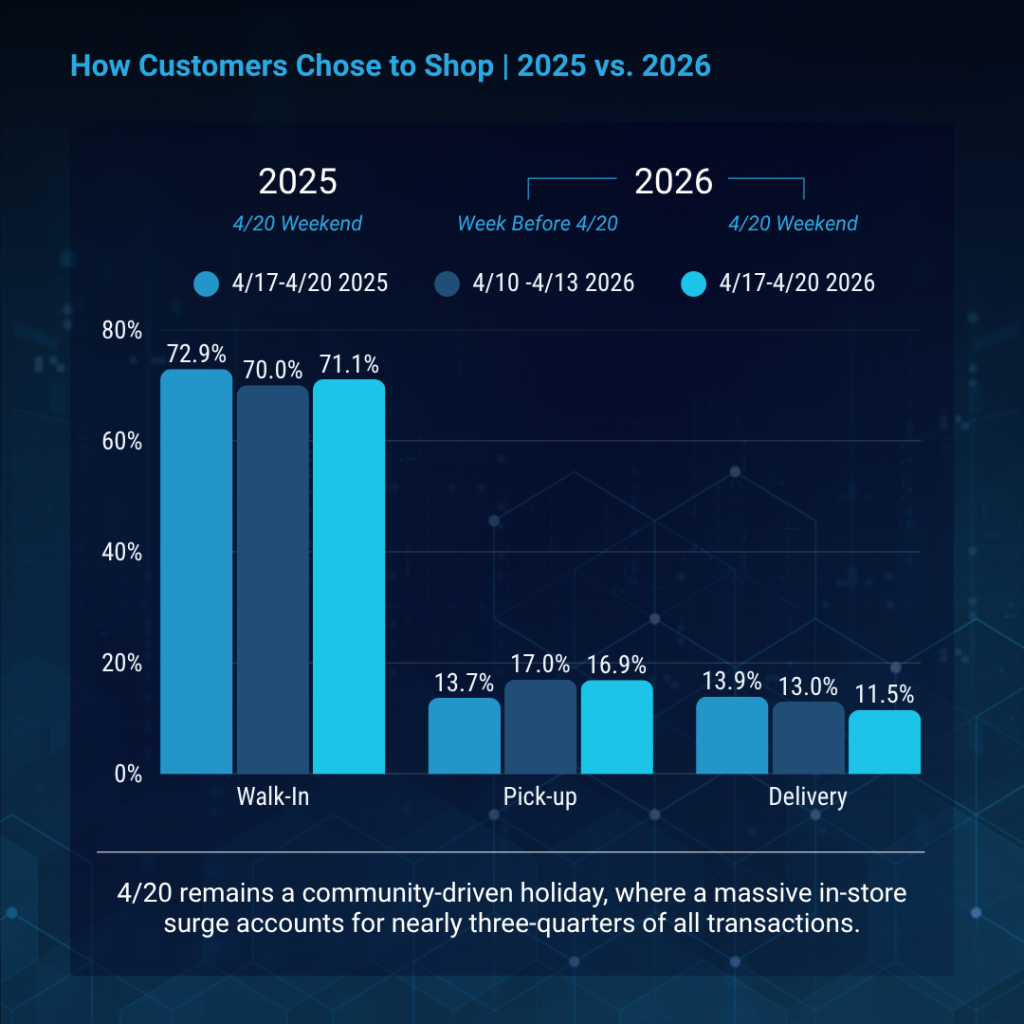
Despite the digital surge, the dispensary experience itself remained central to 4/20. Walk-ins accounted for 71.1% of transactions on the holiday, nearly matching 2025’s 72.9%.
What shifted was the mix of other channels. Delivery dropped to 11.5% (down from 13.9%), while pick-up grew to 16.9% (up from 13.7% in 2025). This signals the rise of the hybrid shopper — someone who orders online via mobile but still wants to be in the store on 4/20. Retailers should recognize that digital channels often serve an in-person purchase decision.
The hybrid shopper represents a fundamentally new kind of customer relationship — one that begins digitally and ends in person. They’ve already decided what they want before they walk through the door, which means the in-store experience becomes less about discovery and more about speed, atmosphere, and reinforcing brand loyalty. Smart retailers are redesigning their floor layouts and staffing strategies to reflect this: faster express pick-up lanes, dedicated kiosk zones for self-directed buyers, and budtenders freed up to focus on the genuinely undecided.
The implication for marketing is equally significant. If nearly 17% of your customers are placing orders online before coming in, your digital touchpoints — your app, your website, your email campaigns — are directly influencing foot traffic. A well-timed push notification with a 4/20 deal doesn’t just drive an online order; it drives someone through your door. Operators who think of their digital and physical channels as separate are leaving money on the table. The hybrid shopper proves they are one continuous journey.
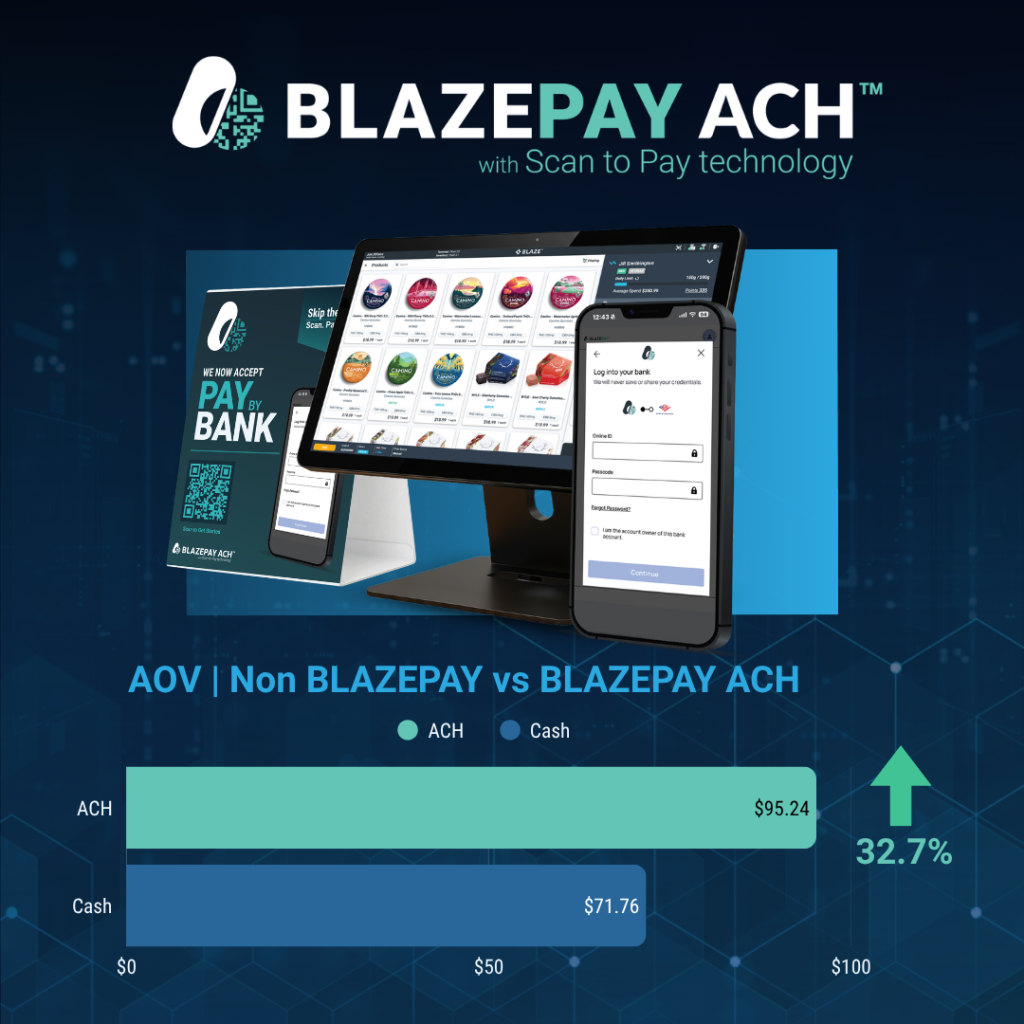
ACH Payments Deliver 32.7% Higher AOV and 27% Volume Growth
Cannabis payment processing has historically been complicated, but 2026 confirmed that digital payments have reached a tipping point. ACH (Automated Clearing House) aka Pay-by-Bank is a compliant, purpose-built payment solution — and the revenue case is just as strong as the compliance case.
ACH transactions averaged 32.7% higher AOV compared to other payment methods, and overall ACH volume grew 27% year-over-year. When customers aren’t limited by cash on hand, they spend more. Digital payment acceptance is a revenue multiplier for cannabis dispensaries.
The psychology behind this spending lift is worth understanding. When a customer walks in with $60 in cash, their budget is fixed and visible — every additional item they consider requires a mental subtraction. ACH removes that ceiling. A customer paying digitally thinks in terms of what they want, not what they have on hand, which is precisely the mindset that leads to larger baskets. Add AI-powered recommendations into that same checkout flow and you have a compounding effect: a customer who is both primed to spend more and being actively guided toward higher-value products.
For operators still relying primarily on cash, the competitive disadvantage is growing. Dispensaries offering ACH are not just capturing more revenue per transaction — they’re also building cleaner financial records, reducing cash-handling risk, and creating the kind of frictionless checkout experience that drives repeat visits. In a regulated industry where banking access has historically been a barrier, ACH represents a rare opportunity to operate more like a mainstream retailer. The dispensaries that adopt it now are setting a standard that will be table stakes within two years.
100% Uptime: The Foundation Every Other Win Is Built On
None of these gains matter if your system goes down. 4/20 is the ultimate stress test for cannabis retail software. BLAZE’s proven track record of 100% uptime means that when your POS, e-commerce platform, kiosks, and mobile app all need to perform simultaneously under peak load, they do.
Total reliability is the silent infrastructure behind every result on this list.
What the 4/20 2026 Data Means for Your Dispensary
This year’s results provide a clear roadmap — but these highlights are only the beginning. To compete in an increasingly digital cannabis retail landscape, you need the full picture of consumer trends, regional performance, and channel-specific growth strategies.
Download the full 4/20 Retail Report to access deeper data and learn how to implement these strategies in your dispensary. Don’t just react to the market — lead it.