
Minnesota Cannabis Retail Software: How to Evaluate Payments First
When you evaluate Minnesota cannabis retail software, start with payments. Federal banking rules still shape every transaction, so you need to know which cashless options the vendor supports, whether pay-by-bank (ACH) works at the register and online, how payments reconcile at close and how the payment layer sits inside Metrc reporting, ID checks and purchase limits. This guide gives you the test list.
Key takeaways
- Payments are the line item most demos skip, yet they decide how much cash sits in the safe and how long closes take.
- Test cashless and ACH options on the floor and online, including failure handling, before you look at any other feature.
- Payment records must reconcile with POS sales and Metrc, so the payment layer should live inside the retail platform.
Why do most cannabis retail software demos skip payments?
Minnesota cannabis retail software gets judged on the wrong feature first. Walk into most cannabis retail software demos and payments get maybe five minutes at the end, after inventory management, after reporting dashboards, after the loyalty module walkthrough. That ordering is backwards for a Minnesota dispensary.
Payment processing is not a feature to check off. It is the constraint that shapes how much cash sits in your safe overnight, how long your budtenders spend counting drawers, and how much average order value you lose because a customer did not have enough cash on them.
If you are doing $200K to $500K a month and comparing platforms, payment capability should be one of the first things you evaluate, not the last. Everything else in a retail software stack, from inventory to loyalty, assumes payments already work. In cannabis, that assumption does not hold.
How do federal banking restrictions affect Minnesota dispensary payments?
Minnesota licensed adult-use cannabis retail through the Office of Cannabis Management, and the state’s regulatory framework is real and enforceable. But state legalization does not change federal banking law, and that gap has not closed just because Minnesota opened a licensed market.
Many banks and card networks still treat cannabis transactions as higher risk or decline to process them at all. The result is that dispensaries end up running on a patchwork of cash, cash-adjacent workarounds, and payment processors that can disappear with little warning.
This is not a Minnesota-specific rule. It is a structural fact about the cannabis retail category everywhere in the US, and it means the software you choose has to be built with that constraint in mind rather than bolted on after the fact. A retail platform that treats payments as an afterthought will leave you exposed exactly where you can least afford it.
What should you test when evaluating cashless and ACH payments?
Cashless payment terminals on the floor
When you evaluate Minnesota cannabis retail software, test payments the way you will use them. When you demo a POS system, do not just ask if it supports cashless payments. Ask to see the terminal process a transaction, watch how long it takes, and ask what happens if the processor has an outage.
Ask whether the cashless option integrates with the same POS screen your budtenders already use, or whether it requires a second device and a second login. Every extra step at checkout during peak hours costs you throughput, and Housing Works has processed more than 100 transactions per hour at peak on BLAZE, which is the kind of speed a fragmented payment setup cannot sustain.
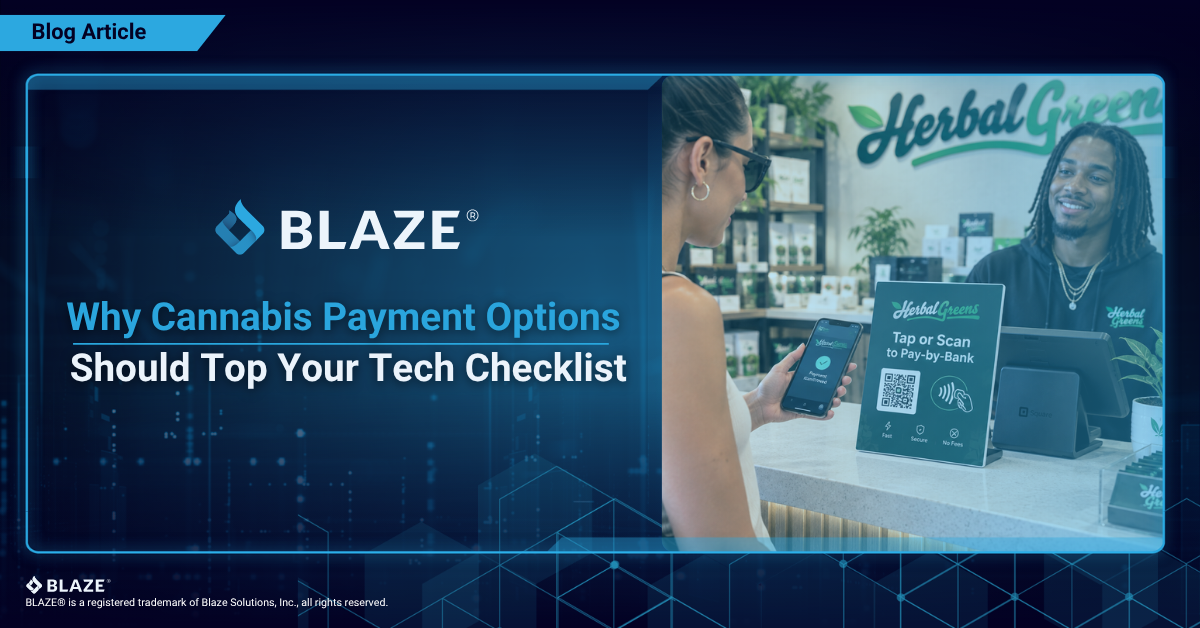
ACH and Pay-by-Bank for online orders For online and pickup orders, ask specifically about ACH support, which shows up to customers as Pay-by-Bank. BLAZEPAY ACH lets a customer connect a bank account once, and every order after that completes in one click. That matters for two reasons. First, it removes a friction point that causes cart abandonment. Second, it tends to produce higher order values than cash.
Across BLAZE’s platform data, prepaid online ACH orders average $130 compared to $60 for in-store cash purchases. Haven Dispensaries saw a 25% AOV uplift from Pay-by-Bank and 39% higher AOV compared to cash. Housing Works saw a 55% AOV uplift tied to BLAZEPAY. These are customer-specific results, not a guaranteed outcome for every store, but they point to a consistent pattern worth testing for yourself.
Where payments connect to the rest of your stack The harder question is what happens to that payment data after the transaction closes. Does it flow automatically into your inventory counts, your loyalty program, your accounting software?
BLAZE integrates with QuickBooks for accounting and Lendica for financing, so payment activity does not live in an isolated silo you have to reconcile by hand at month end. If a vendor cannot answer how payment data moves into reporting, that is a gap you will feel every time you close the books.
How do payments fit inside the Minnesota compliance checklist?
Metrc reporting tied to every sale
Minnesota uses Metrc as its seed-to-sale tracking system, which means every gram has to be accounted for from cultivation through final sale. Payment processing cannot run as a separate system from that reporting. When a cashless or ACH transaction closes, it needs to trigger the same inventory deduction and Metrc reporting that a cash sale would, without a manual sync step that introduces error or delay.
ID verification at the point of sale and online Minnesota law requires every cannabis customer to be 21 or older, both in person and online. A compliant POS needs a built-in ID scanner for in-store sales and a third-party age verification step for online orders. Payment flow and age verification need to work together at checkout, not as two disconnected checks a staff member has to reconcile manually.
Purchase limit enforcement at checkout Minnesota purchase limits are enforced at the point of sale, and in BLAZE Retail this is a configurable setting rather than a manual lookup. Whatever payment method a customer uses, cash, cashless terminal, or ACH, the limit check needs to happen at the same checkout step, before the payment finalizes.
What belongs on a Minnesota cannabis retail software evaluation checklist?
When you sit down with a vendor, bring a specific list rather than a general one. Ask what cashless options are available today, not on a roadmap. Ask how ACH and Pay-by-Bank work for repeat customers, and whether reordering takes one click or requires re-entering bank details every time.
Ask how payment data reconciles with Metrc reporting and your accounting software. Ask what happens during a processor outage and whether the platform has a documented uptime track record. BLAZE’s platform uptime runs at 99.99%, and One Plant California ran through five consecutive
4/20s, the highest-volume day in cannabis retail, without an outage. That kind of reliability is what you are actually buying when you evaluate payment infrastructure, not just the interface.
What does a working payment setup look like in a Minnesota dispensary?
This is what Minnesota cannabis retail software looks like when payments are designed in. Haven Dispensaries did not treat Pay-by-Bank as a checkout convenience. They treated it as a revenue lever, and the 25% AOV uplift and 39% gap over cash orders reflect that.
Housing Works built a similar result into a broader launch, generating $12M in revenue in its first six months while running BLAZEPAY as part of its core checkout flow.
Neither outcome came from payments alone, but in both cases payment processing was foundational to the numbers rather than incidental to them. For a Minnesota operator comparing retail software, that is the standard to hold vendors to.
Not whether they support cashless and ACH in some limited form, but whether payment processing is built into the platform closely enough to move average order value, cut checkout friction, and hold up under Metrc reporting and ID verification requirements at the same time.
Book a demo to see how BLAZE runs POS, e-commerce, payments, and loyalty on one platform.
More on Minnesota cannabis retail software: Pay-by-Bank for dispensaries | cannabis POS software | dispensary loyalty and marketing automation
Related Minnesota guides
- Minnesota dispensary POS: Metrc, ID scans and purchase limits
- Minnesota cannabis retailer operations: daily checklist
- Dispensary software in Minnesota: tech stack consolidation
Sources: Minnesota Department of Revenue cannabis tax, Minnesota OCM licensing process, Minnesota OCM Metrc guidance. Last reviewed October 2026.
Back to the Minnesota resource hub for more on Minnesota cannabis retail software.